Buying raw land in Pine can feel full of promise until the details start stacking up. A beautiful parcel may still have major hurdles involving access, platting, utilities, floodplain limits, or wildfire compliance. If you are thinking about building a home, horse property, or mountain retreat, you need to evaluate the land like a project site, not just a scenic piece of acreage. Let’s dive in.
Why Raw Land in Pine Needs More Review
In Jefferson County, zoning and platting are not the same thing. Zoning tells you what uses may be allowed and what standards apply, while platting addresses whether the parcel was legally created or modified in a way that can support development.
That distinction matters because a parcel can look fine on paper and still require more review before a building permit is possible. Jefferson County also notes that planned development districts can have site-specific rules, so you want to verify the actual parcel details early.
A smart first step is checking the parcel in Jefferson County’s mapping tools. Those tools can help you review zoning, permits, nearby applications, tax data, and district information before you spend time and money moving forward.
Check Zoning and Plat Status First
Before you focus on house plans or views, confirm what the land is legally allowed to do. Jefferson County states that every piece of land in the county is zoned, and vacant land stays zoned until it is changed.
You also need to know whether the parcel has been properly platted. County guidance says land that has been created or modified generally must be platted, with limited exceptions such as some parcels over 35 acres.
If you plan to build a custom home, add an accessory structure, or keep horses, the permit path matters as much as the zoning label. For horse buyers in particular, Jefferson County says horses are allowed only in some zone districts and under certain conditions, and HOA covenants may be stricter than county rules.
What to verify early
- Current zone district
- Whether the parcel is legally platted
- Minimum lot size and setback rules
- Whether horses are allowed under the zoning
- Whether barns, loafing sheds, fences, and gates will need permits or zoning compliance review
- Whether there are HOA rules that further limit use
Legal Access Is Not the Same as Easy Access
One of the biggest raw-land mistakes is assuming a visible road means reliable legal access. Jefferson County says access can be established by a deeded right-of-way, recorded ingress and egress easement, or private road of record, and that access must be at least 20 feet wide.
That is only the starting point. You also need to know whether the road or driveway can realistically support construction traffic, daily use, and emergency response.
At the time of building permit, Jefferson County requires driveways longer than 50 feet and any portion of a road on the subject property to meet county transportation standards. If a private road serving the parcel is not on the property, the applicable fire protection district must inspect it and provide a written statement about whether it is acceptable for emergency vehicle use.
When an access permit may apply
If your driveway connects to a county-maintained road, Jefferson County requires an Access Permit. The county says that permit covers only the first 15 feet of a driveway for residential roads and the first 25 feet for arterial roads.
If work is happening in county right-of-way, a separate construction permit may also be needed. In some cases, new driveway or access-point work can be reviewed together with grading or land-disturbance permits.
Road Maintenance Can Affect Long-Term Cost
In mountain and foothill areas, road maintenance is a serious ownership issue. You should never assume Jefferson County will maintain a private road just because people use it regularly.
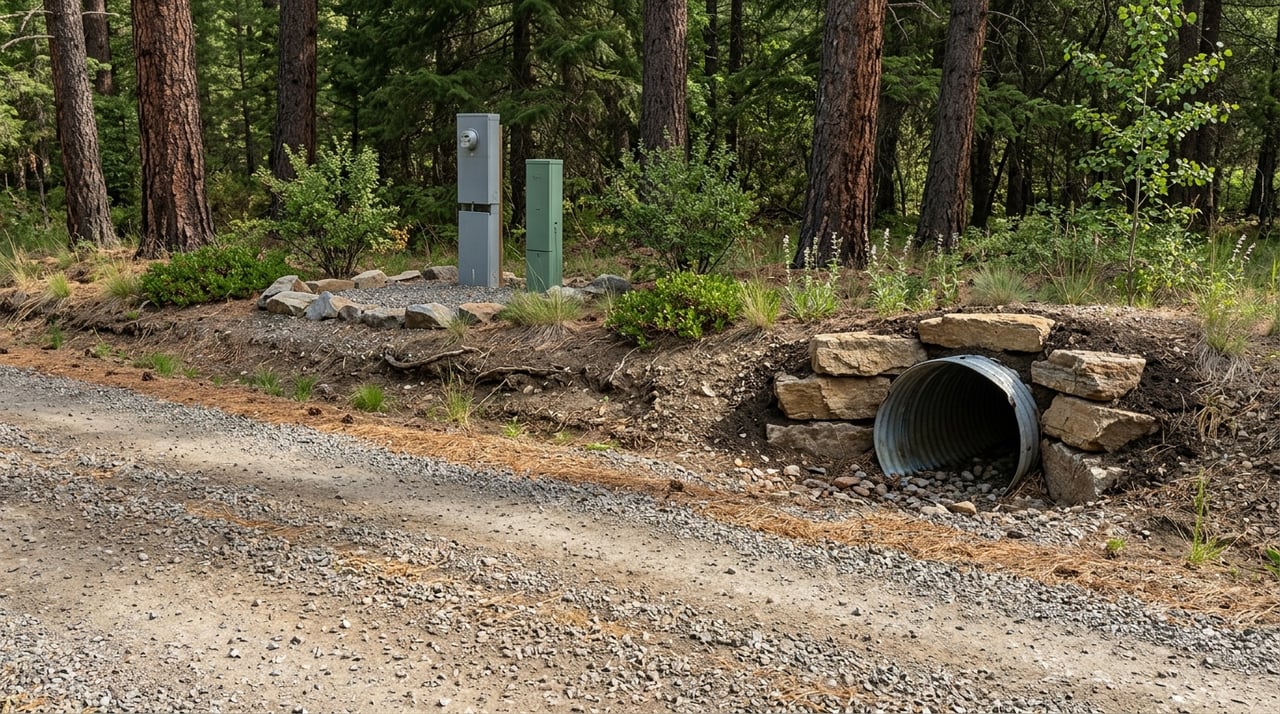
The county says it will accept and maintain a road only if the road has been deeded and dedicated to the county, built to current standards, paved to 24 feet wide, includes three-foot shoulders on each side, and has proper drainage structures such as culverts. That sets a high bar.
For you as a buyer, the practical takeaway is simple: ask for every recorded document that explains who pays for plowing, grading, culvert work, and repairs. If there is a road association or maintenance covenant, review it before your contingency deadlines expire.
Verify Water, Septic, and Utility Serviceability
Raw land in Pine does not come with automatic utility access. Jefferson County states that waterlines and sewer lines are the property of water and sanitation districts, so you need to verify district boundaries and actual serviceability rather than assume a parcel can connect.
For a future home, the county reviews access, water, wastewater, and fire protection or mitigation during permitting. The county also states that dwellings may not be placed in easements or floodplains.
If the parcel depends on a private well, Colorado’s Division of Water Resources is the permitting authority for new or replacement wells. Its records can show allowable uses and construction records, which can be critical if your plans go beyond simple household use.
Why equestrian buyers should pay attention
Jefferson County states that if a well supplies the property and the owner wants to keep large animals, the well permit must allow watering of large animals. For horse buyers, that can be a deciding issue.
A parcel may feel perfect for equestrian use, but the well permit may not support the use you have in mind. That is why water rights and permit limits should be reviewed early, not after closing.
Septic questions to answer
If the property relies on an on-site wastewater treatment system, Jefferson County requires a use permit before sale for systems installed more than five years before the sale date. You should also request existing septic records and confirm whether the site conditions support your intended home size and layout.
Topography and Site Conditions Matter More Than You Think
In Pine, buildability is often shaped by the land itself. Slope, drainage, retaining needs, and the location of the safe build envelope can all change project cost.
Colorado’s hazard-planning guidance says development applications often need maps of existing conditions and may need to identify floodplains, topography, steep slopes, geologic hazards, and wildfire hazards. Counties may also require reports from trained foresters, licensed geologists, or engineers when hazards are present.
Jefferson County adds that projects requiring grading of more than a half-acre will likely trigger grading review through a Grading Permit or Notice of Intent. In geohazard areas, dwelling permits may also require soils testing and a geotechnical report.
Review Geologic Hazards and Floodplain Early
Jefferson County identifies slope failure and landslide hazards, subsidence over abandoned mine workings, and dipping bedrock as local geologic issues. That means your due diligence should go beyond the view and ask whether the site can safely support a foundation, septic field, and driveway without major mitigation work.
Floodplain review should happen just as early. Jefferson County says any work in a FEMA or county-designated floodplain requires a Floodplain Permit.
Depending on the project, the county may require a Colorado-licensed engineer’s flood study and additional map-related approvals. If any part of your likely build area is affected, your timeline and budget can change quickly.
Wildfire Compliance Is a Core Pine Issue
Wildfire is not a side note in Pine. It is one of the main due diligence items.
Jefferson County says more than two-thirds of the county lies within a designated Wildfire Hazard Overlay District. The county also states that updated wildfire regulations, including the Jefferson County Wildfire Resiliency Code, WUI Overlay Map, and related amendments, are effective July 1, 2026.
Current county standards matter now as well. Under Section 39, Jefferson County says no building permit may be issued for a new structure, replacement structure, or addition until written evidence from a county-qualified wildfire interface fire specialist shows defensible space and fuel-break thinning have been completed, or a wildfire-mitigation site plan has been reviewed and a special exception granted.
The county also states that maintaining defensible space is the landowner’s responsibility. For buyers, that means wildfire mitigation is not only a construction issue. It is an ongoing ownership cost.
Practical wildfire budgeting items
Colorado State Forest Service guidance notes that the home ignition zone is the area around a structure that is modified to reduce fire hazard. Priorities include:
- A Class A roof
- Removal of leaves and needles from roofs and gutters
- Vent screening with 1/8-inch metal mesh
- A 5-foot debris-free zone around foundations and decks
- Keeping slash piles at least 30 feet from the home
That guidance also applies around detached garages, barns, storage buildings, and similar structures. If you are planning a compound or equestrian setup, wildfire mitigation may affect more than just the main house.
Talk to the Fire District Before You Close
Parts of Pine are served by Elk Creek Fire Protection District. The district asks prospective land buyers and builders to contact the fire marshal in advance with the property address and intended use so the district can identify fire-code requirements.
Even if a parcel is served by another district, Jefferson County still requires the applicable fire protection district to inspect certain private road situations and provide a written emergency-access statement. That makes fire district input an important part of your early investigation.
Smart Contingencies for a Raw Land Contract
A strong contract can help protect you while you investigate the parcel. In Pine, that usually means contingencies tied to the items that most affect buildability, cost, and timeline.
Here are the issues worth addressing before you close:
- Title, survey, and access: Confirm legal description, easements, right-of-way widths, and the exact basis for legal access.
- Road maintenance: Verify who maintains the road, who pays for snow removal and culverts, and whether any association documents apply.
- Zoning and platting: Confirm the zone district, plat status, and whether your intended use fits the parcel.
- Utilities: Seek written confirmation on water, sewer, electric, well, and septic feasibility where applicable.
- Site conditions: Review slope, drainage, floodplain, geologic, and grading issues before you commit.
- Wildfire: Confirm whether overlay rules, defensible space, and mitigation costs fit your plan and budget.
The Bottom Line on Buying Land in Pine
In Pine, acreage alone does not equal buildability. Jefferson County’s rules make it clear that access, zoning, platting, utilities, geologic conditions, floodplain limits, and wildfire compliance all deserve close review.
If you are buying land for a custom build, mountain retreat, or equestrian use, careful due diligence can protect both your budget and your long-term plans. The right parcel is not just beautiful. It is one you can realistically and confidently use the way you intend.
When you want experienced guidance on complex foothills properties, raw land, access issues, and mountain-area due diligence, connect with Dawn Zalfa. Her local knowledge and legal-grade attention to detail can help you evaluate Pine land with clarity and confidence.
FAQs
What does due diligence for raw land in Pine include?
- It usually includes reviewing zoning, plat status, legal access, road maintenance responsibility, water and septic feasibility, utility serviceability, floodplain conditions, geologic hazards, and wildfire compliance.
Does a raw land parcel in Pine need to be platted before you can build?
- Jefferson County says land created or modified generally must be platted, with limited exceptions, so you should verify plat status early when evaluating buildability.
Can you assume a road to Pine land is county maintained?
- No. Jefferson County will maintain only roads that meet specific dedication and construction standards, so private-road maintenance responsibility should be confirmed before closing.
What should horse-property buyers verify for raw land in Pine?
- You should confirm the zoning allows horses, check whether HOA rules are stricter, and review whether the well permit allows watering of large animals if the parcel uses a private well.
Why is wildfire due diligence important for land in Pine?
- Jefferson County places major importance on wildfire mitigation, and building permits may require defensible space compliance or a reviewed mitigation plan, which can affect both budget and timeline.
What utility issues should you investigate before buying raw land in Pine?
- You should verify whether water and sewer districts serve the parcel, confirm electric access, review well permit details if applicable, and check septic records or feasibility if the property will use an on-site system.