Buying a small ranch in Bailey can feel exciting right up until the practical questions start piling up. Can you keep animals there? Is the water source reliable? Will the driveway work in winter, and can you add the barn or loafing shed you have in mind? If you are drawn to Bailey for acreage, privacy, and mountain access, this guide will help you focus on the due diligence that matters most before you commit. Let’s dive in.
Why Bailey Appeals to Small Ranch Buyers
Bailey offers a more rural, acreage-first setting than many more built-out foothills areas. In Park County, it is known for acre-sized parcels, mountain terrain, and access along U.S. 285, which makes it appealing if you value land, privacy, and a more self-reliant lifestyle.
That lifestyle comes with tradeoffs. Park County notes that the area is largely vehicle-dependent, many subdivisions lack sidewalks or practical pedestrian access, and Highway 285 can experience congestion. County data also shows a median commute time of 38.2 minutes, with 84% of workers employed outside the county.
For many buyers, that is not a drawback so much as a planning issue. If you are purchasing in Bailey, it helps to think of the property not just as a home, but as a small system that depends on access, utilities, land use, and upkeep all working together.
Start With Zoning and Parcel Legality
Before you fall in love with a barn site or pasture layout, verify what the property legally allows. Park County states that zoning determines what structures are permitted and when they can be built, and Planning and Zoning reviews setbacks, parcel legality, and land-use compatibility.
This step matters because the county also warns that an assessor’s account type is not the same as a zone district. In plain terms, you should not assume a parcel supports your intended use just because it is described a certain way in a listing or tax record.
Questions to ask early
- What is the actual zoning district?
- Are your intended uses permitted under that zoning?
- Could your plans trigger a land-use change, conditional use permit, variance, rezoning, subdivision action, boundary line adjustment, or lot consolidation?
- Are there deed or documentation issues tied to parcel size or recording history?
Park County also notes special documentation rules for some parcels under 35 acres, including added requirements for certain non-subdivision parcels and a pre-1972 recorded warranty deed requirement for agricultural parcels under 35 acres. That makes early title review and land-use review especially important for small ranch buyers.
Understand Water Before You Close
Water deserves close attention in Bailey. Park County says private wells provide water for most homes and businesses in the county, and private wells are not regulated. That means the burden is on you to confirm records, testing, and practical performance.
The county’s Bailey water information also highlights PFAS testing activity in Burland Ranchettes, where follow-up testing found elevated PFAS in eight of 14 private wells. Even if a property is outside that specific area, the broader lesson is clear: water testing should be part of your normal due diligence, not an optional extra.
Water due diligence checklist
- Confirm whether the property uses a private well or another source
- Pull available well records
- Review allowable uses in the well file
- Budget for water-quality testing
- Consider possible filtration or replacement costs if needed
At the state level, the Colorado Division of Water Resources says a permit is required for a new or replacement well, and complete applications may take up to 49 days to process. The state also notes that a permit is not guaranteed before full evaluation, so timing matters if your plans depend on a new well or changes to the existing setup.
Review Septic and Site Approval
In Bailey, septic is a major part of purchase planning. Colorado rules place county-level permitting responsibility on systems with flows of 2,000 gallons per day or less, and Park County’s development guide says Environmental Health must approve that the septic system is adequate before a building permit is issued.
That means a small ranch purchase is not just about whether a house exists today. It is also about whether the on-site wastewater system supports the property’s intended use, especially if you are considering additions, outbuildings tied to use, or future improvements.
Septic items to review
- Existing septic or OWTS permits
- Transfer-of-title requirements
- Site-evaluation records
- Whether Environmental Health approval aligns with intended use
Park County’s applications and permitting resources include septic, driveway, site-evaluation, and transfer-of-title checklists. For buyers, that is a useful reminder that utility and site approvals should be reviewed long before closing day.
Confirm Access, Driveway, and Winter Use
A beautiful parcel is only as usable as its access. Park County specifically includes driveway standards and driveway permits in its permitting system, which tells you access is not a casual detail in this market.
You will want to confirm legal access, driveway design, and who handles year-round road maintenance. On a small ranch, daily function depends on whether you can reliably reach the home, trailers can navigate the approach, and winter conditions are manageable.
Access questions that matter
- Is the access legal and clearly documented?
- Does the driveway appear to meet county standards?
- Who is responsible for maintenance and snow removal?
- Will the route work for service vehicles, deliveries, or horse trailers?
Communications should be treated like a utility too. Park County is advancing the Bailey Broadband Initiative to support improved internet infrastructure, but availability can still vary. If you work from home, stream heavily, or rely on connected systems, confirm service early.
Plan Pasture and Hay Realistically
Small ranch buyers often picture green pasture and simple horse setup, but Colorado small-acreage land needs realistic management. CSU Extension says dryland small-acreage pastures are challenging but manageable, with attention to carrying capacity, rotational grazing, weed control, soil health, and drought planning.
For horse properties, CSU Extension offers an especially helpful benchmark: on Front Range small acreage, it can take roughly 25 to 40 acres to support one horse without supplemental feed. In practice, that means many Bailey properties may be horse-manageable, but not self-sustaining from pasture alone.
What that means for you
- Do not assume pasture alone will support animals
- Inspect vegetation and overall pasture condition
- Plan for supplemental hay purchases
- Think about grazing records and weed management
- Match animal goals to the land’s actual carrying capacity
This is one of the biggest mindset shifts in a Bailey purchase. “Horse-ready” may mean the property can function well with thoughtful management, not that the land will fully feed livestock on its own.
Inspect Fencing With a Practical Eye
Fencing is easy to underestimate until you own acreage. CSU Extension notes that rural and mountainous landowners should think carefully about fence responsibilities and wildlife impacts when keeping livestock off a property.
In a transaction, that means you should inspect fence line condition, gate function, visibility, and any obvious maintenance issues. It is also smart to understand how fencing interacts with neighbors, access routes, and intended animal use.
A fence is not just a boundary feature. On a small ranch, it is part of day-to-day operations, safety, and maintenance cost.
Treat Barns and Outbuildings as Major Improvements
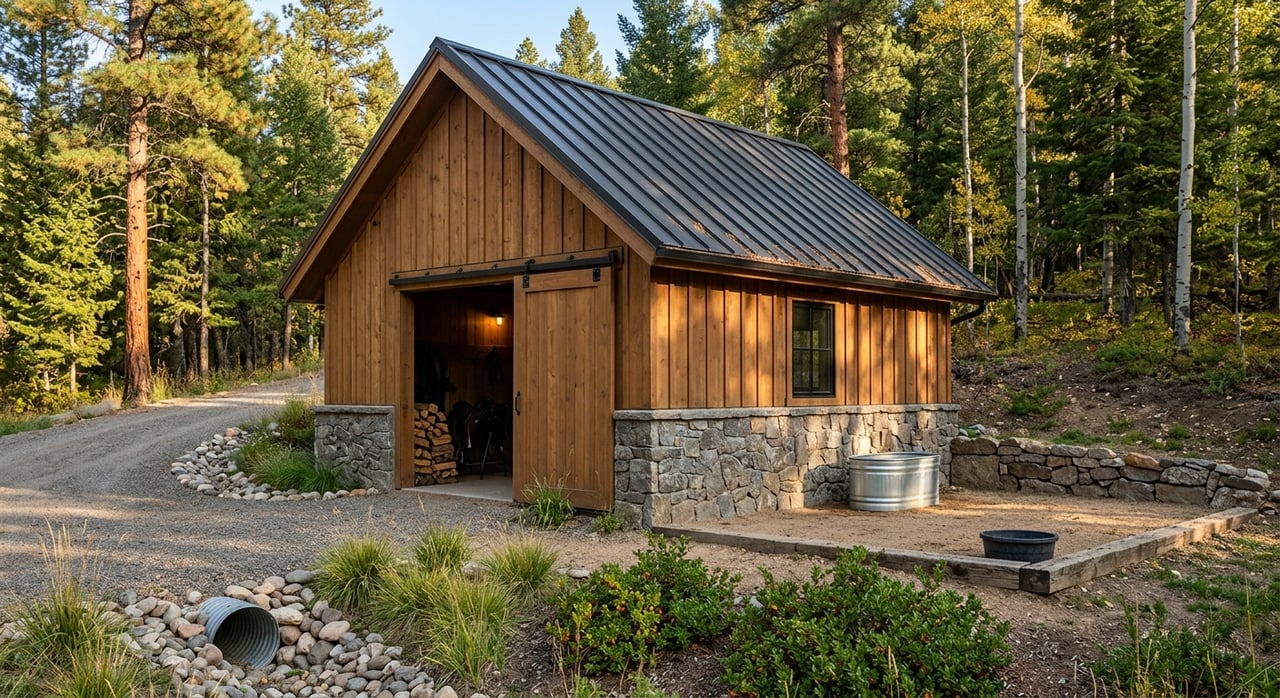
In Park County, barns, tack rooms, loafing sheds, arenas, and similar structures should not be treated as minor add-ons. The county says a permit is required to erect, construct, enlarge, alter, repair, move, improve, remove, convert, or demolish any building or structure.
The county’s development guide also states that Park County is under the 2018 International Code family and requires plan data for snow load and a 115 mph wind load. That is a strong signal that mountain outbuildings need careful design and review, not rough sketches and assumptions.
Before planning an outbuilding, review
- Zoning and permitted structures
- Building permit requirements
- Site layout and setbacks
- Snow-load and wind-load design expectations
- Whether outside specialists may be needed
Park County’s development services information points applicants toward engineers, soil engineers, surveyors, erosion-control consultants, and wetland professionals. For acreage buyers, that is a practical clue that even modest rural projects often involve technical review.
Include Wildfire in Site Planning
Wildfire planning should sit alongside your review of pasture, fencing, and building layout. Park County adopted a Wildland-Urban Interface fire risk classification map in April 2026, which reinforces how important fire-risk screening is for mountain and foothills properties.
If you are considering a small ranch purchase, think about defensible space, access for emergency response, vegetation management, and where future structures would sit on the land. A property can be beautiful and still require meaningful mitigation planning.
Looking at wildfire in isolation is not enough. The best approach is to evaluate access, outbuildings, fencing, and land management as one connected system.
Build a Bailey Due Diligence Plan
Bailey can be an excellent fit if you want acreage, privacy, and mountain access. The key is understanding that these properties often require more hands-on review than homes in more urbanized foothills locations.
A smart purchase plan usually includes early review of zoning, parcel legality, title details, well records, water quality, septic status, driveway access, broadband, pasture condition, fencing, and wildfire risk. When you address those items up front, you are in a much better position to judge whether a property truly fits your goals.
That is where experienced local guidance matters. In a market like Bailey, the right property is not just attractive on paper. It is legally usable, physically workable, and aligned with how you actually want to live.
If you are considering a small ranch purchase in Bailey and want a careful, risk-aware approach to acreage, access, and land-use details, connect with Dawn Zalfa for trusted foothills guidance.
FAQs
What makes Bailey attractive for a small ranch purchase?
- Bailey appeals to buyers who want acre-sized parcels, privacy, mountain access, and a more rural lifestyle with access along U.S. 285.
What should buyers verify about zoning for a Bailey ranch property?
- You should verify the actual zoning district, permitted uses, setbacks, parcel legality, and whether your plans could trigger a permit, variance, rezoning, subdivision, or other land-use action.
Why is water testing important when buying in Bailey?
- Park County says most homes and businesses use private wells, and county water information shows local PFAS testing activity, so buyers should review well records and include water-quality testing in due diligence.
What septic review is important for a Bailey acreage purchase?
- Buyers should review septic or OWTS permits, transfer-of-title requirements, site-evaluation records, and whether Environmental Health approval supports the intended use.
Can a small ranch in Bailey support horses on pasture alone?
- Not always. CSU Extension says it can take roughly 25 to 40 acres to support one horse without supplemental feed on Front Range small acreage, so many buyers should expect to purchase hay.
What access issues should buyers check on a Bailey ranch property?
- Buyers should confirm legal access, driveway standards, maintenance responsibility, winter usability, and whether the route works for daily living, deliveries, and trailers.
Do barns and loafing sheds need permits in Park County?
- Yes. Park County says a permit is required for building or improving any structure, and outbuildings must also meet code and site-review requirements.
Why should wildfire planning be part of a Bailey ranch purchase?
- Wildfire risk affects site design, defensible space, access, and structure placement, so it should be reviewed alongside pasture, fencing, and outbuilding plans.